


7 high-impact AI in transport use cases (with examples)
There’s no shortage of AI in transport use cases being talked about. From chatbots to predictive maintenance, operators have found some pretty neat ways to use AI in transport. Some of which have the potential to change how networks are planned, fleets are run, and major operational decisions are made.
So, where should operators be paying attention?
We’ve picked seven AI opportunities that we think could make a big difference to transport operations, alongside real examples of how they’re already being put to work.
Read on for the opportunities. Or, if you’re already thinking about where AI could make a difference in your operation, talk to our transport AI team.
Key takeaways
|
1. Predicting passenger demand before it happens

Operators have always used passenger data to help plan services. But as we all know, yesterday’s travel patterns don’t always tell you what will happen tomorrow. Weather, events, school holidays, changing working patterns, and the time of year affect how many people turn up at a stop and when.
AI can bring those different data points together to create much more detailed demand forecasts. So, instead of knowing that a route is usually busy on a Friday afternoon, an operator could predict where demand is likely to rise or fall and use that insight to make better decisions about capacity, vehicle allocation and future services.
There are already examples of this in action.
Keolis Nederland used deep learning to predict passenger demand on its bus network. The model combined smart-card passenger data with weather information to understand how conditions affected ridership. According to Keolis, adding weather data improved forecast accuracy by 27% on weekdays and 66% on weekends.
And this is where things really start to change.
Forecasts can then feed into decisions about where buses are needed and how the network should be designed. Better forecasting helps operators reduce unnecessary capacity on quieter services while responding earlier to routes where demand is growing.
Plus, as operators gain access to richer sources of passenger information, planning teams can continuously update their understanding of how, when, and where people are travelling.
2. Building a network that continuously optimises itself

Planning a bus network means balancing a huge number of moving parts. AI can help operators analyse these factors together, using real operational data to identify where services could work better. That might mean spotting timetables that consistently struggle at certain times of day, identifying where frequency no longer matches demand, or finding opportunities to improve vehicle allocation.
We can already see this happening in Greater Manchester.

Transport for Greater Manchester (TfGM) is using CitySwift’s AI-powered platform across the Bee Network. The technology analyses network data to identify trends and performance issues, while its AI recommendation engine tests different optimisation scenarios and recommends changes based on factors including punctuality, cost, and vehicle requirements.
And there are measurable results. CitySwift reports that its partnership with TfGM has contributed to a 10% improvement in punctuality on key routes, alongside smarter vehicle allocation.
Instead of relying solely on periodic reviews, teams can continually analyse service performance, understand where problems are developing, and use that evidence to make changes.
As more operational data becomes available, AI could also help planners test different frequencies, running times, and service patterns before putting them into place, giving them a clearer idea of the likely impact on passengers, vehicles, and costs.
➡️ Related reading: Predictive maintenance in bus fleets
3. Making electric fleets easier to operate

It’s safe to say, moving to electric buses introduces a whole new set of variables into day-to-day fleet planning. Vehicle range, battery condition, charging times, depot capacity, route requirements, and energy use all need to be considered while still getting the right vehicles onto the right services.
This is an area where AI and optimisation can be particularly useful. By analysing vehicle, route, and charging data together, operators can make the best decisions about which buses to deploy, when to charge them, and how to get the most from their batteries.
RBU Santiago, operated by Transdev, is a good example. The operator used Optibus‘ AI-powered planning and scheduling platform to support the deployment of 245 electric buses in Santiago, Chile. The technology allows planners to account for EV-specific constraints such as charging requirements and driving range when putting together vehicle schedules.
Keolis has taken the idea a step further with its SOH Fleet project. The operator uses AI to analyse electric-bus battery data and assess battery health. During an initial trial involving six buses in Blois, France, the insights helped teams make decisions around charging cycles, vehicle rotation, maintenance and service planning.

That becomes increasingly important as electric fleets grow. Even small improvements in when vehicles charge, how batteries are used, and which buses are allocated to particular routes can affect energy costs, vehicle availability, and the useful life of some of the fleet’s most expensive components.
It could also give operators a much clearer evidence base for future investment. Understanding how batteries and charging infrastructure perform under real operating conditions can help inform decisions about how many chargers are needed, where capacity constraints could emerge and how future electric vehicles should be deployed.
4. Spotting safety risks earlier

Transport operators already collect huge amounts of safety information, from CCTV footage and incident reports, to telematics, and operational data. The challenge is turning all of that information into something teams can act on quickly!
Computer vision and machine learning can help by continuously analysing CCTV feeds and flagging situations that may require attention. That could include a passenger falling, someone entering a restricted area, dangerous behaviour near a platform edge, or overcrowding in a particular location. Longer term, combining this information with wider operational data could also help organisations identify recurring patterns and target preventative action.
Transport for London has already tested this approach at Willesden Green Underground station. Between October 2022 and September 2023, its Smart Stations trial combined existing CCTV with AI algorithms to detect a range of safety, security and operational events. When the system recognised an incident, staff could receive an alert with information to help them decide how to respond.

The trial included detecting people on the floor, customers moving beyond platform safety lines, and people entering unauthorised areas. TfL’s own report says the system successfully detected several occasions where customers had fallen and needed assistance. Following the trial, TfL said it was rolling out Smart Station technology to a further five platforms as part of its work to reduce risks at the platform-train interface.
To be upfront, there were some limitations too.
Some detections produced false alerts and certain behaviours proved difficult for the technology to recognise reliably. That’s why we always talk about why AI needs careful testing and clear human oversight, particularly when safety decisions are involved.
For bus operators, the technology could eventually have applications across depots, stations, and vehicles. The bigger opportunity is to use the information being collected to understand where risks are developing and intervene earlier.
➡️Related reading: Read TfL’s Smart Stations trial report
5. Testing changes before making them in the real world
It’s safe to say some transport decisions are expensive to get wrong. Changing a timetable, redesigning a route, introducing new infrastructure, or responding to a major disruption can have big consequences across the wider network.
Digital twins offer a way to test those decisions first.
They create a virtual representation of a real transport system, bringing together data on areas such as traffic flows, public transport services, and passenger demand. Combine that with AI and operators can model different scenarios and explore their likely impact before making changes on the ground.
The UK has already been exploring what this could look like. The Department for Transport funded a project to develop a blueprint for an urban transport digital twin, involving the Alan Turing Institute, Connected Places Catapult, and researchers from Newcastle, Birmingham, and Manchester universities.

[Image shows an example of the Grafana live dashboard]
One of the scenarios explored how a digital twin could support real-time traffic management. The researchers looked at using AI to predict traffic conditions up to an hour ahead, then simulate different interventions to understand which could best reduce congestion. The same underlying idea has much wider potential: using live and historic data to ask “what happens if…?” before committing to a course of action.
More recently, Tees Valley Combined Authority has been developing a Traffic Digital Twin designed to create a virtual representation of the region’s road network.
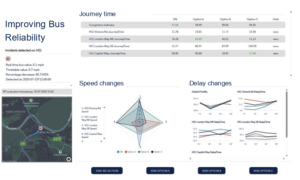
[Example of Aimsun’s bus reliability module evaluation for detected bus delay]
The project brings together real-time traffic data, AI, machine learning, and simulation, with potential uses ranging from identifying congestion and incidents to modelling the effect of changes across the network.
For operators, this could eventually make scenario planning far more sophisticated. What happens to reliability if a major road closes? How would a timetable change affect other services? Where might a new depot create efficiencies? How would a change in passenger demand affect vehicle requirements?
Being able to model more of those consequences in advance could give leadership teams much better evidence for decisions involving high cost or operational risk.
➡️Related reading: Read the DfT urban transport digital twin report
6. Using AI to compete in a franchised market

There’s little doubt that bus franchising is changing things for operators. As more areas move towards franchised models, operators need to assess complex tender opportunities, build competitive bids, and demonstrate that they can deliver against detailed contractual requirements.
This creates an interesting role for AI.
Tender packs can run to hundreds or thousands of pages across multiple documents, covering everything from service specifications and fleet requirements to performance regimes and contractual terms. AI can help bid teams interrogate that information much more quickly: identifying requirements, finding relevant evidence, comparing documents and highlighting areas that need closer attention.
There’s a good example from the Department for Transport (DfT) of what AI can do when teams are faced with huge volumes of complex written information. DfT worked with Google Cloud and the Alan Turing Institute to develop an AI tool to analyse responses to public consultations. DfT runs around 55 consultations each year, with some generating more than 100,000 free-text responses. Google estimates that using AI to support this analysis could save the department up to £4 million a year.
The application is different from franchising, but the capability is highly relevant: using AI to work through large quantities of information, identify themes, and surface the material that people need to make decisions.
For operators, that could be particularly valuable during a competitive tender. AI could help teams interrogate tender requirements, draw relevant information from previous bids, and operational data, compare different service specifications, or identify inconsistencies that warrant further investigation. It could also support scenario modelling around fleet, workforce, and operating requirements as assumptions are developed.
The opportunity continues once a contract has been awarded. AI could help operators monitor performance against KPIs, spot emerging trends, and identify areas where contractual performance may be at risk, giving teams more time to investigate and respond.
With franchising expanding across England, these capabilities could become really valuable. The operators that can turn their operational knowledge and data into better decisions may have an advantage both when competing for contracts and delivering them.
➡️ Related reading: How AI can help bus operators adapt to franchising
7. Giving managers a clearer view of the whole operation
Most operators already have plenty of data. The difficulty is that it tends to live in different places. Engineering has vehicle and maintenance information. Operations has service performance and driver data. Commercial teams have ticketing and passenger information. Finance has costs. And customer teams have complaints and feedback.
This can make seemingly simple questions surprisingly difficult to answer. Why did punctuality fall on a particular group of routes last week? Is the problem congestion, vehicle availability, scheduling or something else? Which services are most at risk of missing their performance targets this month?
AI creates the potential to bring those different sources of information together and make them much easier to interrogate. Instead of working through several reports and dashboards, a manager could ask a question in plain English and receive an answer drawing on information from across the operation.
We can already see individual pieces of this capability emerging in the examples we’ve covered:
- Keolis is using AI to forecast passenger demand.
- TfGM and CitySwift are analysing network performance.
- Electric fleet platforms are bringing vehicle, charging and scheduling data together.
- Digital twins are combining multiple data sources to model what could happen next.
The bigger opportunity comes when those capabilities start connecting.
Imagine an operations director asking: “Which five routes are most at risk of poor performance tomorrow, and why?”
AI could potentially bring together predicted demand, weather, traffic, vehicle availability, and historical service performance to identify where problems are most likely. A manager still decides what to do, with a much richer picture to work from.
Or a fleet director could ask: “Where are we losing the most money through vehicle downtime, and what are the main causes?”
Rather than waiting for several teams to pull together the analysis, AI could interrogate existing operational information and surface the patterns that deserve attention.
This is a more ambitious use case because it depends heavily on the quality and accessibility of an operator’s data. If systems don’t talk to each other or important information is incomplete, an AI layer won’t magically solve those underlying problems.
For operators that get the foundations right, though, the potential is significant. AI could make the enormous amount of information already generated by a transport business much more useful to the people making decisions every day.
Which AI use case should you prioritise first?
The examples above show just how broad the opportunity has become. But few operators have the time, budget, or resources to pursue every promising AI use case at once.
The challenge is deciding where AI can make the biggest difference to your operation.
A useful starting point is to look at these three areas: business value, readiness and complexity.

#1. Business value: Start with the most important outcomes for your operations. If franchising is the immediate strategic priority, bid and contract intelligence may deserve attention first. If electrification costs are rising, fleet and energy optimisation could offer more value. Or if reliability is the biggest issue, network optimisation may be the stronger opportunity.
#2. Readiness: AI needs something solid to work with. Do you have enough relevant data? Can you access it easily? Is it reliable? And do you understand the process well enough to know what a better outcome looks like?
#3. Complexity: Some opportunities are considerably easier to implement than others. Analysing tender documentation could potentially be tested relatively quickly. Building a digital twin or introducing AI into real-time network control requires much more integration, governance and operational change.
A simple way to narrow the options is to start with the pressure you’re trying to solve:

The important thing is to avoid turning this into an AI shopping list. Seven interesting use cases don’t require seven pilots.
For most operators, a better approach is to identify the two or three opportunities with the strongest connection to current business priorities, understand what would be required to deliver them and build a roadmap around the ones with a credible route to measurable value.
Ready to find your biggest AI in transport opportunity?
Working out where AI could help is only the beginning. You also need to know which opportunities are worth investing in, whether your data and systems are ready, what return you can realistically expect, and which technology will deliver it.
This is exactly where Mind The AI Gap can help.
Our team includes former senior transport and technology leaders who understand the realities of implementing change in live transport operations. That includes former Stagecoach Group CIO Graham Moore, former TfL Surface Transport MD Leon Daniels, and Dave Joshua, whose transport technology experience includes Optibus.
We work with transport organisations to:
- Identify and prioritise AI opportunities based on the operational problems you actually need to solve.
- Assess AI readiness, including the data, systems, skills and governance needed to move forward.
- Build the business case and roadmap, so investment is tied to clear outcomes and measurable value.
- Find the right AI solution, drawing on a curated network of technology partners rather than pushing a single platform.
- Support implementation and scale, from initial pilots through to longer-term AI programmes.
So if passenger demand, franchising, fleet electrification, network performance, or another operational challenge is high on your agenda, we can help you work out where AI can make a measurable difference and how to put it into practice.
Talk to Mind The AI Gap about your transport AI priorities and find the right place to start.
Ready to explore where AI could support your operations?
Contact Mind The AI Gap to start the conversation.
info@mindtheaigap.com | 0800 009 6408